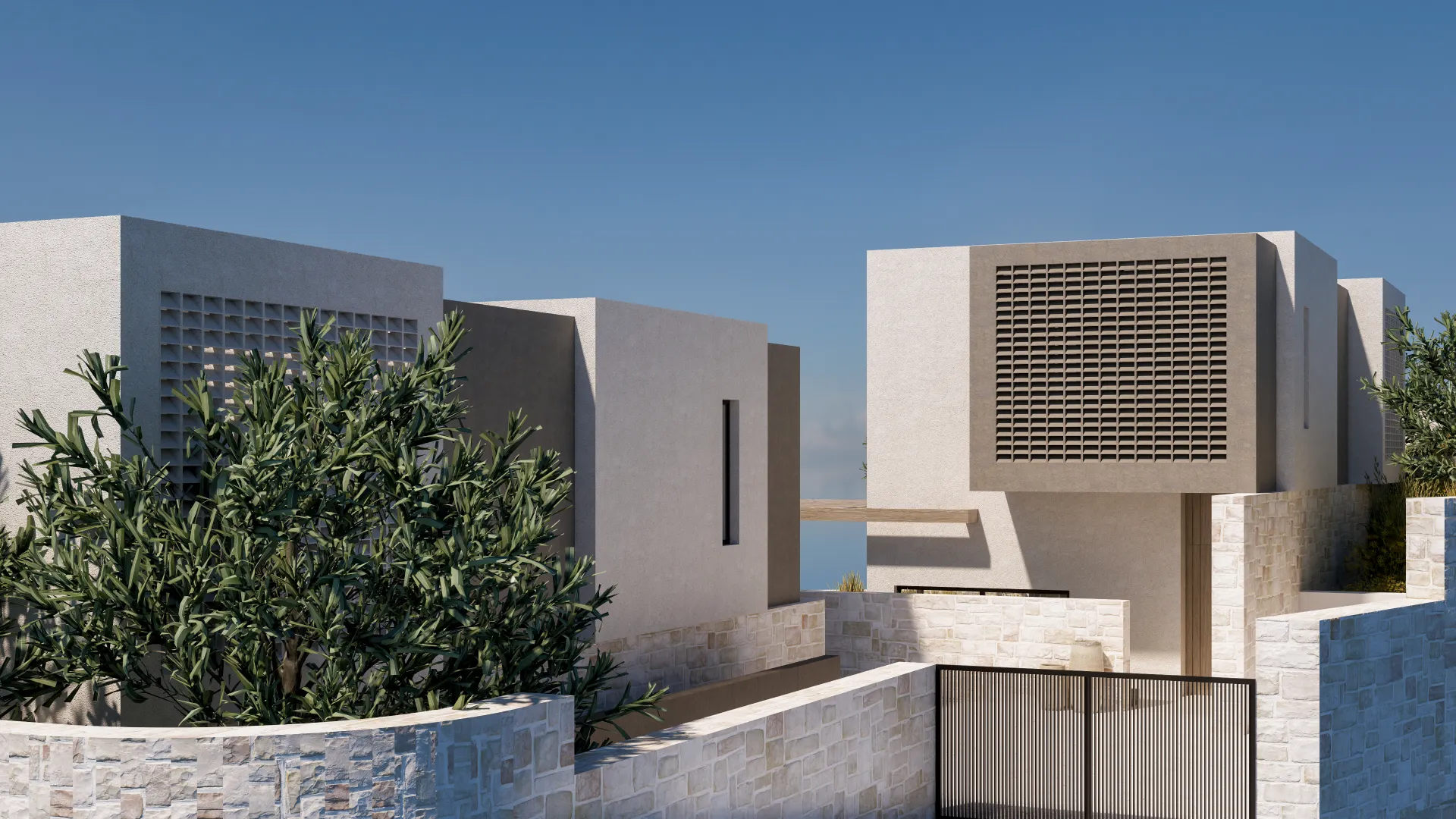
architecture rethymno
The recent decision of the Plenary Session of the Council of State (Decision 1760/2024) brought sweeping changes to the implementation of the New Building Regulation (NOK), declaring several of the so-called “building bonuses” unconstitutional. This decision fundamentally alters the landscape for engineers, investors, and property owners, affecting both new permits and ongoing constructions.
What is considered constitutional and remains in force
Despite the ruling on the unconstitutionality of certain favorable provisions of the NOK, some structural elements continue to be excluded from the building coefficient (FAR). Specifically, stairwells, elevator shafts, and shared-use corridors are not counted toward the FAR, just as was the case under the 1985 Building Code. These are essential functional components that serve safety, accessibility, and the general usability of buildings. Additionally, bay windows—closed horizontal projections—are considered morphological and architectural features with aesthetic and bioclimatic value. As long as they comply with the prescribed dimensions, they are not included in the FAR, since they do not significantly burden the residential environment.
What has been deemed unconstitutional and can no longer be applied
Several favorable provisions of the NOK, which were introduced as “bonuses” to promote bioclimatic design or to reduce site coverage, have been deemed unconstitutional by the Plenary Session of the Council of State (Decision 1760/2024). Specifically, lofts with adequate height and use as primary space can no longer be excluded from the building coefficient, as they effectively constitute fully functional living areas. Similarly, primary-use structures on rooftops—such as independent spaces up to 35 sq.m. with a height of up to 4.20 m—can no longer be exempted from the FAR, since they increase the overall built volume and the density of the area. Likewise, rooftop pools or other water features, which until recently were counted as “green roof” areas, can no longer be equated with vegetation—especially amid environmental challenges like drought. Furthermore, the possibility of increasing the building coefficient in exchange for reducing the lot coverage (by -10%) was also deemed unconstitutional, as it substantially alters zoning terms without being integrated into urban planning frameworks. Finally, height increases of 1 or 2 meters for environmental incentives—such as green roofs or limited lot coverage—are no longer considered lawful, since they were applied indiscriminately and lacked clear spatial justification.
What happens with issued building permits and projects that have already commenced?
The decision of the Council of State does not have retroactive effect on building permits whose implementation began on or before December 11, 2024. According to current clarifications, the commencement of implementation is defined either by the official notification of excavation to the competent administrative authority, or by the submission of an Analytical Periodic Statement (APD) to EFKA by the project’s employer. In these cases, the additional square meters granted through the provisions of the NOK remain valid, and no revision of the permit or other adjustment to the new legal framework is required.
On the other hand, if a permit was indeed issued under the “bonuses” of the NOK but the project has not yet begun, revision becomes mandatory. The additional square meters must be removed, and the permit must be executed based on the currently applicable building coefficients. Additionally, the amounts previously paid by the owner as public charges for these extra square meters are to be refunded.
Inclusion in the Development Law and special cases
Particular attention is required when a building permit that includes the so-called “bonuses” of the NOK has been integrated into a subsidized program, such as one under the Development Law. The recent decision of the Council of State (1760/2024) does not explicitly exempt these projects, which creates legal and practical uncertainty. Nevertheless, the governmental approach currently being promoted—regardless of whether the project has started or not—is the retention of the additional square meters and other privileges of the NOK, upon payment of a fee or levy to the Green Fund. This same possibility is reportedly being proposed for permits that are involved in pending legal proceedings, as part of a transitional framework to avoid revocations.
Attention to detail, importance of sound choices
Even if a building permit was issued before December 11, 2024, and is formally valid, a single complaint does not affect its legal standing. However, there is one critical exception: if any violation or planning infraction is identified in the project, the permit may be destabilized and called into question, even if the formal criteria are met. That is why selecting an experienced, trustworthy, and legally informed technical partner is not only a safeguard but also a prerequisite for investment stability.
Choosing an engineer is not merely a technical matter—it is a question of trust, professionalism, and the legal fortification of your project.